
Shuhari: The Three Stages of AI Mastery
How to evolve from blindly following AI prompts to creatively bending the algorithmic rules.
Shuhari: The Three Stages of AI Mastery
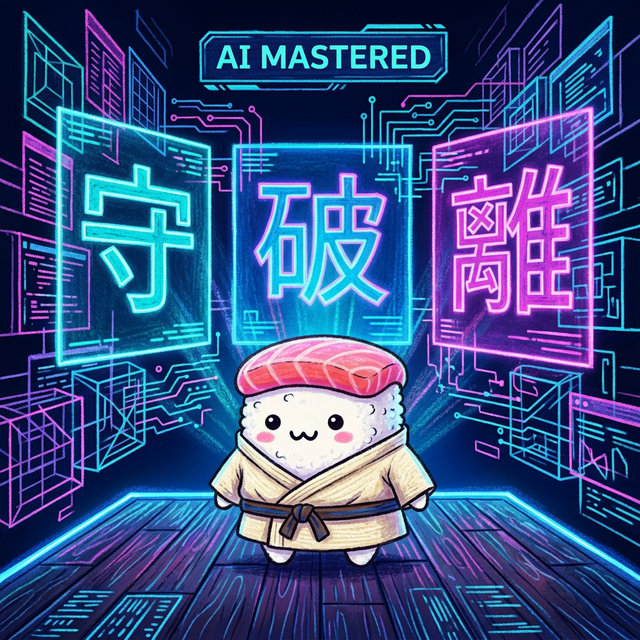
When learning any new skill in Japan, be it martial arts, tea ceremony, or calligraphy, one follows the path of Shuhari (守破離). As we integrate Artificial Intelligence into our lives and work, this ancient framework offers a perfect guide for true mastery, preventing us from becoming mere button-pushers.
1. Shu (守) - Protect / Obey
The first stage is about learning the fundamentals. You follow the rules to the letter. In the context of AI, this means learning basic prompt engineering. You use templates, you understand how the model responds to specific keywords, and you don't deviate from best practices. You "protect" the form.
2. Ha (破) - Detach / Break
Once the fundamentals are mastered, you begin to break the rules. You understand why the rules exist, which allows you to bend them effectively. You start combining tools, writing unconventional prompts, and experimenting with the edges of the AI's capabilities. You innovate upon the established paths.
3. Ri (離) - Leave / Transcend
In the final stage, you transcend the rules entirely. The tool becomes an extension of yourself. You no longer think about "how to prompt"—you simply converse and create. Your own unique style and intuition drive the process, and the AI acts as a seamless collaborator rather than a rigid machine you must operate.
Which stage are you currently at with AI? Mastery is a journey, not a destination.
Master the nuance implicitly.
Join 2,500+ professionals receiving weekly AI-decoded breakdowns of Japanese business etiquette.